
SEO and AEO for Social Media: How to Optimize Your Content for Search
Does SEO work on social media? Absolutely.
Do you know how it works? Maybe not!
Well, have no fear. That’s why Dillon Media Group is here.
When it comes to SEO and social media, there are ways to help your content show up more often in search and get understood by the algorithms deciding what people see. And yes, there are basics to creating a good post, but there are also elements within your posts and profiles that can help social media platforms understand exactly what your brand is about.
Let break it down.
The Basics of Your Social Media Post
1. Is it useful, or are you just selling something?
People are tired of being sold to. Instead, they want to be talked to.
They also want less AI-generated... well, everything.
You can look at this study to learn more about the current state of consumer preferences regarding generative AI in consumer-facing content.
Hint: 50% or more of people surveyed prefer brands that avoid it.
So, is your content useful?
Are you sharing a hot take or opinion as a thought leader in your industry? Are you sharing a high-value tip or a how-to? Even team spotlights bring humanity into your brand without requiring a ton of brain power when it comes to figuring out what to post.
Useful, check.
Now, is it human?
This means you’re not just going to copy and paste a caption from ChatGPT and call it a day.
Before you even write the post, focus on your audience. What do they care about? What do they want to hear? What could they need from you that they haven’t gotten before?
Providing this information in an engaging way is how you make people care about what you’re saying.
2. Now, what helps the algorithm understand your post?
Once you’ve created something worth paying attention to, you can turn to the more technical side of things and help the algorithm understand it.
When creating social media posts, you’ll want to think about:
- Keywords
- Questions
- Locations
- Alt text
- Descriptive captions
- Video captions
- Context, context, context!
These all matter in the world of SEO and, increasingly, AEO.
SEO stands for search engine optimization, and you can learn more about SEO in this other blog post we published.
AEO stands for answer engine optimization. It focuses on making information easy for AI-powered search experiences to understand, trust and potentially reference when generating answers.
SEO is still the foundation of this. Sort of like building a house. You need the foundation first. AEO is another layer built on top of that foundation, helping platforms understand not only what your content is about, but also what questions it answers and if users can trust it.
The Difference Between SEO and AEO
| SEO | AEO |
| Optimizes webpages and content | Optimizes answers and information |
| Focuses on rankings | Focuses on citations and visibility in answers |
| Measures clicks and traffic | Measures discoverability and mentions |
| Uses keywords | Uses questions, context and clear answers |
| Goal: Website traffic | Goal: Brand visibility |
Now, Let’s Go Back to Context
Context is extremely important when it comes to social media platforms like Instagram, Facebook and TikTok. These platforms use artificial intelligence and machine learning to help power search, ranking and recommendation systems.
In other words: the almighty algo.
Platforms look at different signals through the lens of an algorithm to understand things like:
- What topic you’re talking about
- What question you’re answering
- Who might be interested in it
- How people respond to it
- If viewers find it useful enough to watch, save, share or interact with
Now, that last part. What’s the point of social media if nothing is actually social?
While keywords can help a platform understand what your post is about, human behavior gives it an actual clue. When people stop scrolling, watch the video, save the post, share it or leave meaningful comments, those interactions can help show that the content is useful and thus, becomes social because it’s engaging.
That’s why you have to write for people first and the algorithm second.
One simple way to do this is to start a caption or video with a question your audience is asking and then answer it clearly.
Instead of making the platform guess what your content is about, you’re giving it context right away.
Optimize Your Social Media Profile for Search
You can help social platforms understand your business by:
- Adding your city or service area
- Adding your business type or industry to your profile
- Clearly explaining what you do and who you do it for
- Linking to your website, booking page or other relevant resources
- Pinning posts that highlight your services, locations, hours or important information
Basically, don’t make people or the algorithm investigate your profile like it’s solving a mystery.
Just tell them who you are from the jump.
How To Optimize Posts for Search and Discovery
You can also optimize the posts themselves by:
- Asking a question and answering it clearly.
- Using relevant keywords naturally in your caption.
- Adding context through what you say in video and the text you put on screen.
- Adding your city or location when targeting local customers.
- Using descriptive alt text when appropriate.
- Adding captions to video content.
Captions are especially important to pay attention to. They make spoken content more accessible to people who are deaf or hard of hearing, help people understand videos when they’re watching without sound, and give the platform additional text and context around your content.
Most Importantly: Be Social!
At the end of the day, it’s still called social media.
Be yourself. Be your brand. Talk like an actual person.
Try to stay consistent around the topics, services and insights you want your brand to be known for.
You can optimize every keyword perfectly, but if nobody wants to read, watch or interact with what you’re posting, optimization can only take you so far.
An Example of a Good Profile Setup
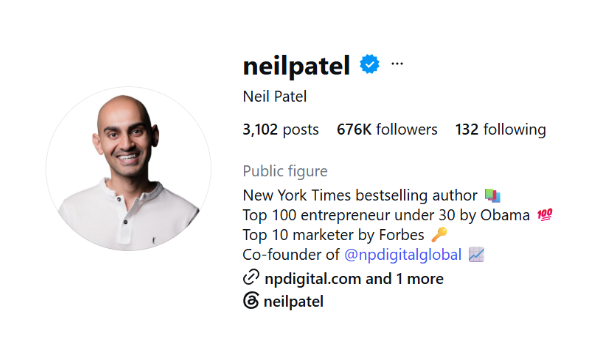
Here’s Neil Patel, SEO guru and, as you can see, bestselling author and entrepreneur.
His profile clearly explains who he is, establishes his credentials and points visitors toward relevant profiles and websites.
An Example of a Bad Profile Setup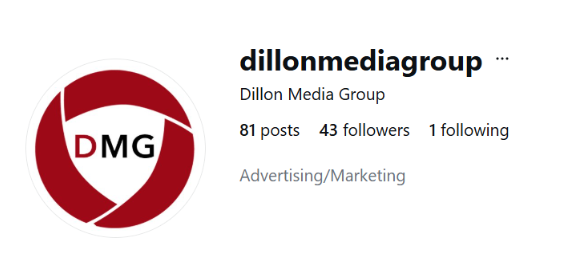
Here’s our Instagram. Don’t worry, this isn’t what our profile looks like now! But take a closer look. The profile essentially just gives you the ‘Dillon Media Group’ name.
Yes, you can see our logo and industry, but there aren’t many other clues telling people or the platform who we serve, where we are, or what our specialties are.
So, let’s fix it.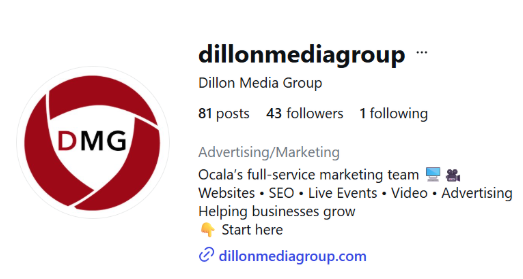
Much better.
Adding a bio to your Instagram or social media profile gives people immediate clarity. In this example, it tells viewers who we are, gives them somewhere to go to learn more about us and helps them quickly figure out if we offer what they’re looking for.
It also tells them where we are, which is especially important for a local business trying to show up in searches related to its city or service area.
Social Media Management For Your Business
You want to make it incredibly easy for people and platforms to understand who you are, what you know, and what you can help with. That’s good social media. It happens to be pretty good SEO, too.
This is the kind of detail we look at for every social media client. If your bio, profile or page isn't doing the work for you, our social media management services are here to help.
Dillon Media Group has been helping Ocala and Marion County businesses show up clearly online for over 40 years. Let’s take a look at your profiles and make sure they're working as hard as they can.