
How Google Ads Work and What Ocala Businesses Should Spend
What is Google Ads?
Google Ads is Google’s online advertising platform. Businesses use it to promote products and services to people who are searching online, mainly on Google Search results, and also on sites in Google’s network such as YouTube. Ads can be text, images, or video, depending on the campaign.
How does Google Ads work?
You pick keywords, write ads, and set a budget
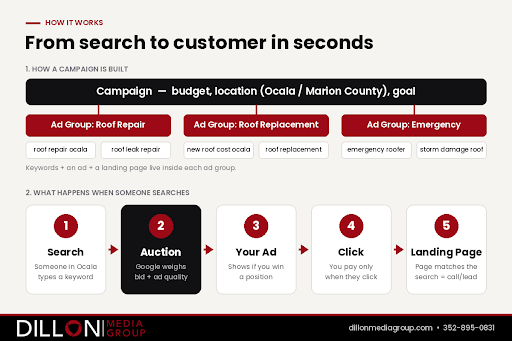
A campaign holds your budget and your location settings, like ‘Marion County’ or a set radius around your shop. Inside each campaign are ad groups, and each ad group sticks to one theme, like “AC repair” or “new AC installation.” Each ad group has its own keywords and ads, and every ad sends people to a page on your website.
Every search runs an auction
Each time someone searches on Google, an auction happens in a split second. Your bid is the most you’re willing to pay for a click. Most of the time, you pay less than your bid.
The highest bid doesn’t automatically win
Google uses something called Ad Rank to decide which ads show and in what order. It weighs your bid, the quality of your ad and landing page, Google’s minimum quality thresholds, the competition, the searcher’s context (like their location, device, and time of day), and the expected impact of extras, like call buttons and sitelinks. According to Google, a more relevant ad can win a higher spot for less money.
You pay when someone clicks
That’s why it’s called pay-per-click. Your daily budget is an average, so Google may spend a bit more on a busy day and less on a slow one, but it stays within your monthly limit. Google Ads also reaches beyond search, with options like YouTube ads.
What are keywords in Google Ads?
Keywords are the words or phrases searched when looking for a product or service. For example, keywords could be any of the following:
- Shoe repair Ocala
- Boats cruises vacation
- Tennis lessons in New York
As shown above, a keyword can be just a single word, several words, or even a phrase. In the context of Search advertising, all of these are simply referred to as a keyword.
Also, notice how “Tennis lessons in New York” includes a place. Location changes intent.
Someone searching “AC repair Ocala” is likely ready to call a local company, while “AC repair” on its own could be someone looking for a DIY video.
Negative keywords protect your budget
Negative keywords tell Google which searches you don’t want to pay for. Common ones include “free,” “jobs,” and the names of towns you don’t serve. This is one of the simplest ways to stop paying for junky clicks.
Match types for Google Ads
Match types determine how closely user searches must match your keywords. There are three main match types. Broad match casts the widest net, phrase match keeps searches close to your meaning, and exact match is just that, exact.
Example keyword: marketing agency Ocala
Broad match lets your ad enter the auction for related searches, even if the words differ, like “advertising company near me” or “help with Facebook ads Marion County.”
Phrase match lets your ad enter the auction when the search keeps your core meaning in order, like “best marketing agency Ocala” or “full service marketing agency Ocala.”
Exact match lets your ad enter the auction mainly for searches that mean the same thing as your keyword, like “marketing agency Ocala” or very close variants.
What does Google say makes a good ad?
Relevance to the search
Write headlines that closely match your keywords, and group your keywords by theme so each ad fits its ad group. If someone searches for “roof leak repair,” your ad should say roof leak repair.
Responsive search ads need options
Google recommends at least 8 to 10 unique headlines (you can use up to 15) and at least 2 descriptions (up to 4). Put a keyword in a couple of headlines, then use the rest for benefits, offers, and what makes you different. It’s best to avoid repeating yourself.
Ad Strength aims for Good or Excellent
Google’s best practice is at least two responsive search ads per ad group, rated Good or Excellent, plus at least six sitelinks. Google also says that your Ad Strength is feedback on how well you filled out the ad, not necessarily a ranking factor in the auction.
Quality Score and its three parts
Quality Score rates each keyword from 1 to 10 based on expected clickthrough rate, ad relevance, and landing page experience. You can think of this as a diagnostic tool.
The landing page has to keep the ad’s promise
If your ad promises a discount, the page should show it. Put your phone number or form near the top, and send people to a landing page that matches your ad instead of your homepage.
Google rewards the ad that’s most useful to the searcher, which is good news for a local business that knows its customers!
How much should an Ocala business spend on Google Ads
The cost of Google Ads depends on how competitive your industry and your market are. A Miami attorney will pay far more per click than an Ocala med spa. Our clients typically start around $1,000 a month in ad spend and go up to several thousand. We actually just hit one million dollars in ad spend, for managed Google Ads campaigns.
The math behind any budget
Start with clicks. Decide how many you need each day to see what’s working (many local accounts aim for about 10 or more). Multiply that by your average cost per click, then by 30 for a month.
Example: 10 clicks a day × $5 per click × 30 days = $1,500 a month in ad spend.
Of course, not every click becomes a lead. If 10% of clicks turn into a call or form submission, 100 clicks would generate approximately 10 leads. At $5 per click, that's $500 in advertising costs, or $50 per lead.
Next, consider how many of those leads turn into paying customers. If all 10 leads are qualified and you close 1 in 4, your customer acquisition cost would be approximately $200.
For a business generating $4,000 in revenue per job, that could be a reasonable investment, depending on profit margins and operating costs. A business with a $200 average transaction would need a very different budget and acquisition strategy.
Budget ranges by industry competitiveness
These are planning ranges, not promises. Before you lock in a number, pull real cost-per-click estimates for your own keywords in Google Keyword Planner, or have someone like Dillon Media Group do it for you.
| Competitiveness | Typical local examples | Typical CPC range* | Starting monthly ad spend | What to expect |
|---|---|---|---|---|
| Lower | Restaurants, attractions and entertainment, travel, auto sales | About $1.50 to $3 | About $500 to $1,000 | Enough clicks to learn within the first month. A good fit for promos and events. |
| Moderate | Retail, auto repair, pet services, fitness, salons and spas, professional services | About $3 to $6 | About $1,000 to $2,000 | One to two months to find winning keywords. Steady leads if your site converts. |
| High | Dental, home improvement, education and training, financial services | About $6 to $9 | About $2,000 to $3,500 | Every click matters. Tight keywords, negatives, and a strong landing page are a must. |
| Very high | Emergency HVAC, roofing, electricians, painting, legal (like personal injury) | $10 and up | $3,500 to $5,000+ | Fewer clicks per dollar. Wins come from high job values and fast follow-up on calls. |
*Cost-per-click ranges are planning ballparks based on national averages from WordStream’s 2025 Google Ads benchmarks. Ocala costs are typically lower than big-city numbers, but they vary by keyword. We can pull your real numbers in Keyword Planner before you set a budget.
Ad spend and management fees
Your ad spend goes straight to Google. If you work with an agency, management is a separate fee for the people building, watching, and improving your campaigns. You can see how we approach it on our Google Ads management page.
What too little looks like
Spending $10 a day in a niche where clicks cost $15, then deciding “Google doesn’t work.” That’s less than one click a day!
What to fund before you scale
- Tracking for calls, forms, and appointments.
- A message-matched landing page.
- Negative keywords and tight targeting.
- A clear offer, so people know what happens when they call.
- Then more budget.
Pouring more money into a leaky website is how Google Ads gets a reputation for not fully realizing its return on investment.
Should you apply Google’s recommendations automatically or manually?
Google’s Recommendations page suggests ways to improve your campaigns, tied to an optimization score from 0 to 100%.
Applying them automatically
Google lets you auto-apply certain types of recommendations. You can review the list, dismiss items, and see what was applied in Change History. Google also says auto-apply won’t raise your budget.
Applying them manually
Implementing recommendations automatically might save time, but you may find that ad optimization is much more targeted when you do it manually, providing you with potentially better results. Some suggestions, like switching to broad match, raising budgets, or adding new keywords, can fit Google’s goals more than a local business’s goals.
Our take
Review your optimization score against your service area, margins, and lead quality. Only auto-apply changes you’d approve every time anyway.
How do you measure whether Google Ads is working?
Track the actions
Set up calls, form fills, bookings, and directions requests as conversions.
The numbers to watch
- Clickthrough rate shows whether your ad is relevant.
- Cost per click, conversion rate, and cost per lead show whether it’s affordable.
- The search terms report shows what people actually typed.
Lead quality also depends on your keywords, ad promise, targeting, and how fast you follow up.
A quick word on attribution
Google Ads uses data-driven attribution by default for most new conversion actions, which spreads credit across the ads that helped lead to a sale.
Older conversions may still be set to last click if they were never updated. We cover what that means for your reports in our post on data-driven attribution.
When to raise or cut your budget
If your cost per customer is healthy, increase your budget. If it’s not, fix your targeting and your landing page before you spend more.
Does Google Ads work better with radio or mail?
Usually, yes. This is how you stay top of mind. Radio and mail build awareness, and Google captures the search that follows. Those branded searches are usually cheaper and more likely to turn into a call.
- Radio builds recall across a local audience.
- Mail puts an offer in specific neighborhoods, with QR codes and offer codes you can track.
- Google Ads catches the people who heard or saw your name, plus the ones already searching for what you sell.
If you run radio or mail, keep a branded and high-intent search budget live while the spots air or the pieces land. Learn more about the radio-to-Google pipeline and what happens after someone reads your mailer.
Ready to see what Google Ads should cost for your business?
The right budget for you will be tied to your cost per click and how competitive your category is. We can also walk you through a realistic range together.
Call 352-895-0831 or email clinton@dillonmediagroup.com, or learn more about our Google Ads management for Ocala and Marion County businesses.